|
TIPS
- Field Dressing. A good
venison meal begins as soon as the deer is harvested. How you
take care of your deer after the shot will have a great deal to do
with how tasty or nasty your next venison masterpiece will be.
The most common errors that hunters make are contamination of the
carcass with intestinal matter, hair, soil, leaves and other
trash. If you do not have a processor near by who can
professionally skin and dress your deer, the first step is to field
dress the deer as soon as possible so the carcass can begin to
cool. Drag the deer to a spot where you have plenty of room to
work and follow these steps:
- You should always carry a sharp hunting knife, a 8-10 foot length
of rope to fashion a drag, a 3
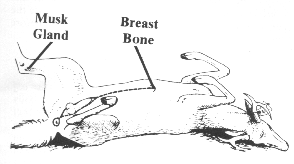 foot length of twine and some paper towels or cloths.
- Prop the deer on its back and with your knife, cut completely
around the anus. Pull it out and tie it off with your
twine.
- Pinch the hide between the hind legs and make a small cut with the
point of your knife. Insert two fingers of your free
hand into the incision and lift the hide away from the inner
skin.
- Using your fingers to keep the hide raised and as a guide for your
knife, carefully cut the hide from the anus opening to the
breast bone. Always cut from the inside of the hide to
reduce the amount of hair contamination and be careful not to
cut the abdominal muscles and intestines.
- Once you have completed your cut, roll the deer on its side.
Pull the tied off anus through the pelvic opening and roll the
intestines out on the ground. Be careful when removing
the bladder that you do not cut or puncture it. Reach into
the chest cavity, cut the esophagus and pull it out.
Pull out any remaining organs.
- Use your paper towels to clean any remaining blood clots etc out
of the cavity and to clean your hands. Disposable
plastic gloves are also a handy item to carry.
- If you have to drag your deer any distance at all to get it out of
the woods, it’s probably not advisable to split the pelvis
or chest bone. this will reduce the likelihood that dirt
and debris will get into the body cavity. Drag the deer
head first so that the natural bend of the hair will not pick
up excessive dirt and debris
- Refrigeration. Your deer
should be refrigerated as soon as possible. If the air
temperature is above 50 degrees as it often is in the South, the
carcass should be refrigerated within 3-4 hours of the kill. If
that is not possible, pack the body cavity with as much ice as
possible until you can completely dress your deer.
- Aging Venison. A number of
hunters like to age their deer to tenderize the meat. To
properly age a deer, the hide should be left on and the deer
refrigerated at 34-36 degrees for up to 2 weeks. However, most
hunters do not have the facilities to hang their deer in such a manner
and processors must remove the hide before bringing deer into their
facilities. Removing the hide exposes the meat to cold dry air
and causes excessive dehydration and consequently, higher trimming
losses. Generally speaking, it is better to go ahead and process
the deer within 3-4 days of the kill due to the dehydration problems
and the contaminates that are usually present.
- Cooking. Venison can be a
delicious change of pace from the beef, chicken, pork routine or it
can be like eating Luther’s boot. The key is understanding
that venison is a naturally lean meat. It has very little fat
cover and what it does have, does not contribute to the flavor of the
meat. When preparing venison for cooking, as much fat, tallow
and silver skin as possible should be trimmed off. Since venison
has very little fat itself, your recipe should provide some
replacement to enhance the flavor. Butter, bacon strips, cheese
and even larding with beef fat will help. Don’t overcook
venison. Venison steaks and roasts have a better flavor when
they are still pink inside. Try different seasonings, marinades
and sauces to compliment venison’s natural flavor. Also,
choose a method of cooking that adds moisture back to the meat.
Simmering in a sauce, frequent basting, and slow cooking in a crockpot
are examples of how to keep your venison from drying out.
- Yield- A frequently asked
question is, “How much meat will I get out of that deer?” It
is a hard question to answer with precision because you can never be
sure until the deer is cleaned just how much meat has been damaged by
the bullet. However, the following guidelines I read in a recent
Field & Stream piece by Dave Hurteau seemed reasonable based on my
experience. He said that for the average mature buck, about 26%
will be offal. No, I didn’t make a spelling error; believe it or
not, the “awful” stuff-blood and guts- most hunters would rather
not handle, is called “offal”. Roughly another 20% is hide and
bones and another 15% or so is fat and sinew that should be
trimmed. So what does that leave us? About 40 % of the
deer would be useable meat. That would mean that a 70 pound doe
would yield about 28 lbs of useable meat; a 140 lb buck would yield
about 56 lbs. There are other factors such as gender, age, diet,
and etc that might affect the yield of any particular deer but 40% is
a good average. Also to be considered when getting your deer
processed by a commercial processor like the RWC is the type products
you choose. If you choose to have fresh deer sausages or deer
burger products which have either pork or beef trimmings added, the
net yield will often be greater than 40%. However, smoked
sausages, bologna, pepperoni and summer sausages will lose some weight
during the smoking process and may cause the net yield to be a little
less than 40%. The RWC makes a conscientious effort to maximize
your yield while insuring that we don’t package anything for you
that we wouldn’t want to eat ourselves.
- Safe to Eat:
Click HERE to open QDM aritcle.
- The RUT: Hunters are constantly
asking me, "Do you think the Rut is in?" The Rut is that
magical time when the natural wariness of male deer is superceded by
their primal need to mate. This is also the time when most
wall-hangers are taken. However, it comes at different times based on
a number of variables. The Georgia DNR has conducted a study of deer
movements based on reported collisions with cars to produce what they
call a Rut Map. Perhaps this may be of use to you this year as you
plan your hunting trips. http://www.georgiawildlife.com/rut-map
Wildlife
Traditions
Mike Allen Taxidermist
Alan
Braddy
255 Dewayne Dikes Rd
2269
GA Hwy 86
Vidalia, GA 30474
Lyons,
GA 39436
912-537-2636
Office:
912-526-6492
Cell:
912-585-1623
True
Image Taxidermy
Fins & Fur Taxidermist
John
Williams
Garland & Zack Peebles
941
West Liberty Ave
62 Starfish Lane
Lyons,
GA 30436
Lyons, GA 30436
912-585-1620
478-494-8959 (Garland)
912-326-3014 (Zack)
Home || Recipes
Tips || Rackettown Wildlife Club
Seasonings
|| Case Sales
|